



Jan 21, 2026
Real differences between official and university-specific master’s degrees: how to know which one is right for you based on your goals
Understand the difference between official and private master’s degrees. They may seem similar, but the truth is that they have different functions, recognition, and objectives.
If you are wondering what an official master’s degree is, what a private master’s degree is, whether it is worth doing a private master’s degree, or which one to choose for your professional career, here I explain it clearly with practical examples so that you can make an informed choice.
Translated with DeepL.com (free version)
What is an official master’s degree?
An official master’s degree is regulated by the Ministry of Education and is recognized throughout the European Higher Education Area.
This means that:
- It has international academic validity.
- It allows access to doctoral studies.
- It counts towards competitive examinations or public competitions.
- It requires a highly structured curriculum.
If you are considering moving to another city to study an official master’s degree, remember that having a suitable environment for studying is key. At StepHouse, for example, you can find student residences in cities such as Madrid, Seville, Malaga, and Granada, which can help you choose the best place to study:

What is a university-specific master’s degree?
A university-specific master’s degree is a program created directly by the university or educational center, without state regulation.
Its characteristics:
- More flexible and up-to-date content.
- Teachers who are usually active professionals.
- Practical and employment-oriented approach.
- It is usually more affordable.
This option suits many people because they are looking for quick and useful specialization. And if you opt for a master’s degree in another city, it is important to make sure you have a comfortable place to live, study, and socialize. You can explore the type of modern and equipped rooms that StepHouse offers for students who move away for their studies.
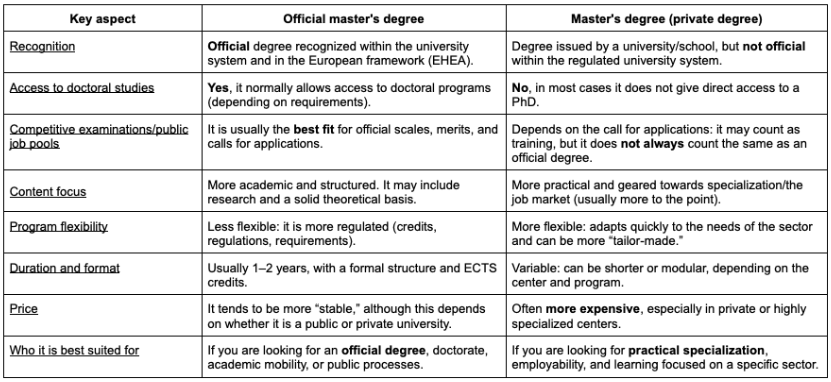

Key differences between official degrees and university-specific degrees (explained simply)
Here is a clear summary of the difference between official master’s degrees and university-specific master’s degrees, so you can decide based on your goals:
Recognition
- Official: valid at the state and European level.
- University-specific: recognized by the university and by companies, but not official.
Access to doctoral studies
- Only official master’s degrees allow direct access to doctoral studies.
Focus
- Official: academic and research-oriented.
- Private: professional, practical, and oriented toward the job market.
Flexibility
- Private: content is updated more quickly.
- Official: more fixed structure.
Price
- Private master’s degrees are usually more affordable.
Your environment matters as much as your academic choice
Regardless of whether you choose an official master’s degree or a university-specific degree, there is another key factor that influences your academic performance: the environment where you study and live.
Having a residence that offers comfort, services, emotional stability, and a good atmosphere can make all the difference. At StepHouse, for example, you not only have accommodation, but also:
- Social and sports activities.
- Adapted study spaces.
- Common areas to unwind.
- An international community of students.
If you are going to study away from your city, knowing what your residence has to offer will help you get the most out of the experience.

Conclusion: there is no universal answer, there is your answer
The difference between an official degree and a university-specific degree is not meant to complicate your life, but rather to help you choose what really suits you.
- If you want to do research, a PhD, or take competitive exams → Official master’s degree.
- If you want to learn practical skills and improve your employability → Private master’s degree.
And if you’re moving away to study, remember that your experience can be even better if you choose an environment that supports you, both socially and academically. A residence like StepHouse can become your balance between studying, living, and enjoying your university years.
FAQ 1: What is the difference between an official master’s degree and a university-specific master’s degree?
The difference between an official master’s degree and a proprietary master’s degree lies in the type of recognition and its academic validity. An official master’s degree is regulated by the university system, is officially recognized in Spain and the European Higher Education Area, and normally allows access to a doctorate. In contrast, a private master’s degree (or master’s degree with its own title) is created by a university or school with a more practical and specialized approach, but it is not official like an official master’s degree. Therefore, before choosing, it is a good idea to review your goals: if you need an official degree, a doctorate, or to sit competitive examinations, an official master’s degree is usually better; if you are looking for specialization and quick employability, a private master’s degree may be more suitable.
FAQ 2: Does a university-specific master’s degree count toward competitive examinations, or is an official master’s degree better?
It depends on the call for applications, but in general, if your goal is to sit a competitive exam, it is safest to choose an official master’s degree, as it usually has the best chance of scoring as a merit on official scales. Many users search for this as “difference between a university-specific degree and an official degree,” because a university-specific degree may not be valid in some competitive examinations or public processes, or may score lower. Even so, there are calls for applications where a university-specific master’s degree can count as complementary training, so it is advisable to always review the specific scale for your competitive examination before deciding.
FAQ 3: Is it worth doing a private master’s degree or is an official master’s degree better?
Yes, it is worth doing a university-specific master’s degree if your priority is to improve your professional profile in a short period of time, gain specific skills, and access more practical and up-to-date content. University-specific master’s degrees tend to be more oriented towards the job market, with more flexible and specialized programs, which is why many people choose them when looking for a career boost or a change of sector. However, if you need an officially recognized degree, access to a doctorate, or a formal requirement for certain processes, it is best to opt for an official master’s degree. The ideal choice depends on whether your goal is more academic (official) or more professional (university-specific).
Publicaciones relacionadas
¿Quieres leer más?



Request information
Take a step into
your new adventure
your new adventure